

Ask a Geologist Common Q&A
I am a water resource specialist with ADWR. One of my responsibilities is to calculate the amount of water being used in groundwater basins based on our water demand sectors of municipal, ag, and industrial uses. these basins are outside the AMAs so groundwater pumping is not required to be reported. The Upper Hassayampa/Aqua Fria Basin has many gold mines. Specifically, I hope you have an estimate of how much water a gold mine uses, based on type (i.e. underground, placer, screening plant, etc.). I need just a rough estimate.
AZGS Answer
Hi Cyndi,
Thanks for your interesting question about water usage in gold mining. As a bit of background, managing water is one of the most important environmental considerations at mining operations. The most common uses of water in mining are in processing ore (e.g., grinding, flotation) and in watering mining roads to suppress dust (Stevens, 2010). The sources of water for mining in Arizona vary depending on the local geography, but include aquifers, Central Arizona Project (CAP), surficial waters, captured precipitation, and even water from the mine itself if the mine is being actively dewatered (Singh, 2010).
Estimates for average water consumption at a mine site vary considerably based on the processing method applied (e.g., heap leaching, flotation, gravity), but a global summary for water withdrawals for gold mines found the ‘average’ gold mine used ~0.350 m3/metric ton of ore-grade rock (Gunson, 2013). As such, the annual amount of water used will depend on how much mineralized material is being mined each year. While this doesn’t give a nice average use, it is more robust as it considers the size of the operation. The current water usage due to gold mining in the Upper Hassayampa and Agua Fria basins should be fairly low to our knowledge as there are no significant gold operations active in the area, with the historic gold mines in the area being defunct. What little gold production is happening is due to a few relatively small placer operations and rare, very minor pilot operations to test some of the historic mines. A larger source of water in the area is likely from industrial minerals (e.g., sand and gravel) mining operations.
Cheers,
Carson Richardson (AZGS Economic Geologist)
References:
Gunson, A. J., 2013, Quantifying, reducing, and improving mine water use: Unpublished Ph.D. dissertation, University of British Columbia, Vancouver, 258 p. URL: https://open.library.ubc.ca/cIRcle/collections/ubctheses/24/items/1.0071942
Singh, M. M., 2010, Water consumption at copper mines in Arizona, Arizona Department of Mines and Mineral Resources, Special Report 29, 16 p. URL: http://repository.azgs.az.gov/uri_gin/azgs/dlio/1295
Stevens, R., 2010, Mineral exploration and mining essentials: Port Coquitlam, British Columbia, Pakawau GeoManagement, Inc., 322 p.
Question: I have been collecting specimens of banded magnetite Jasper along orme road in Yavapai county. The rocks do not seem to come from this area. Where is the formation and how did my rocks come to be where I am finding them?
AZGS Answer
Chris,
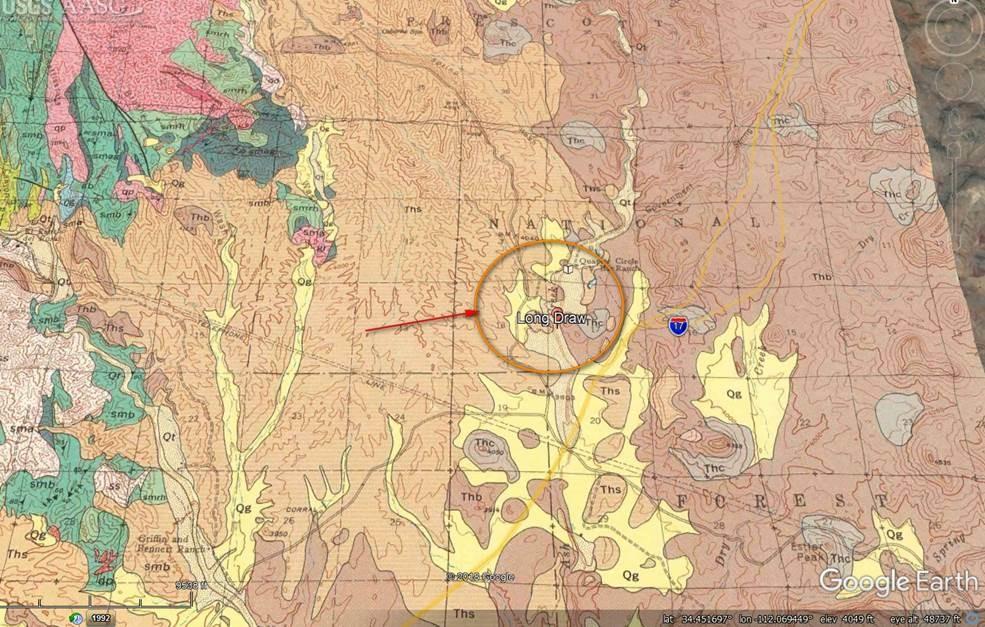
I’m attaching a snippet from the USGS Mayer geologic quadrangle published in 1972. The Long Draw area is surrounded by sediment largely drawn from the Hickey Formation – mostly Miocene age basalts. There are banded iron deposits in AZ.
Below this map is a coarse map showing the iron deposits from AZGS Bull 180. You can retrieve the map and additional info from our Bulletin 180 - http://repository.azgs.az.gov/uri_gin/azgs/dlio/1005 See Part 3, p. 10 – 17 (p168 to 182 in the document.)
Good luck with it. Mike
U.S. Geological Survey Geologic Quadrangle Map GQ-996 U.S. Geological Survey Geologic Quadrangle Map GQ-996
As a retired person I'm involved in a activity known as Earthcaching. This is partly sponsored by the Geological Society of America and involves traveling to different geological features and answering some basic questions. One of these features I was directed to was just east of the Yuma Proving ground and the questions related to volcanic activity, this feature is located at 33.108983 -114.310528. My question for you is this hill the remnants of a cinder cone volcano as it's represented to be? I've not had any formal geology training but have completed several of these Earthcaches and what is represented as a volcano appears to me as a highly eroded mesa. I would appreciate if you could confirm or deny this location is volcanic in nature, thanks!
AZGS Answer
Hi Thomas,
Well it is certainly conical, but conical shape does not a cinder cone make. I copied the description for that area from our 1:1,000,000 scale map and pasted it below.
I don't believe this hill is or was a cinder cone. The rock debris certainly looks like basaltic rubble, but more likely to be associated with lava flows. Mike
Middle Miocene to Oligocene Volcanic Rocks (11-38 Ma)
Lava, tuff, fine-grained intrusive rock, and diverse pyroclastic rocks. These compositionally variable volcanic rocks include basalt, andesite, dacite, and rhyolite. Thick felsic volcanic sequences form prominent cliffs and range fronts in the Black (Mohave County), Superstition, Kofa, Eagletail, Galiuro, and Chiricahua Mountains. This unit includes regionally extensive ash-flow tuffs, such as the Peach Springs tuff of northwestern Arizona and the Apache Leap tuff east of Phoenix. Most volcanic rocks are 20-30 Ma in southeastern Arizona and 15 to 25 Ma in central and western Arizona, but this unit includes some late Eocene rocks near the New Mexico border in east-central Arizona.
Hi, Can you point me to some geologic publications for the South Mountains of Phoenix? Nicole
AZGS Answer
Hi Nicole,
Steve Reynolds (Arizona State University) has a marvelous geologic map and accompanying description for the South Mountains.
Reynolds, S.J., 1985, Geology of the South Mountains, Central Arizona. Arizona Geological Survey Bulletin-195, 75 p., 1 map plate, scale 1:24,000.
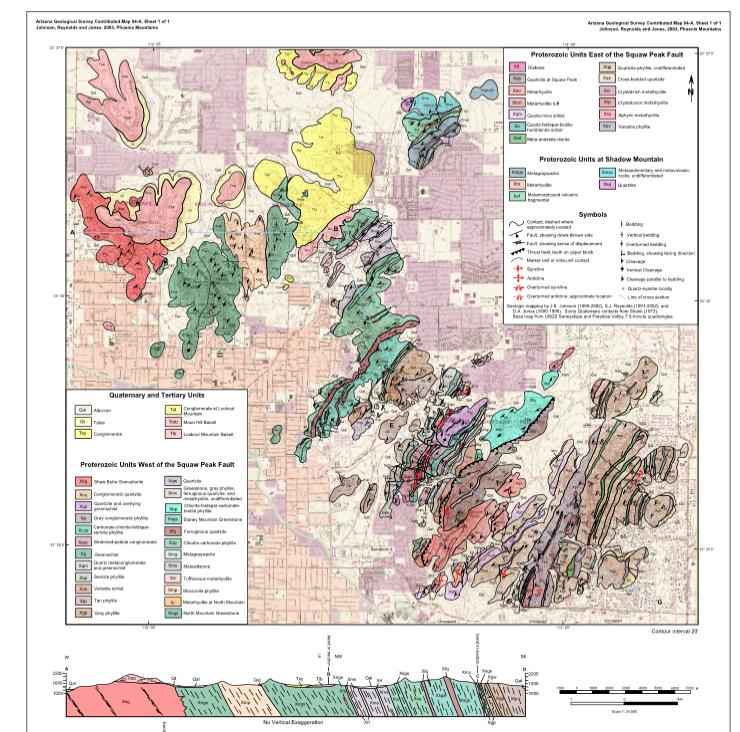
And if you are interested, Julia Johnson field trip guide to the Phoenix Mountains is excellent, too.
Johnson, J.A., Reynolds, S.J., and Jones, D.A., 2003, Geologic map of the Phoenix Mountains, Central Arizona: Arizona Geological Survey Contributed Map CM-04-A, map scale 1:24,000, 16 p.
Enjoy the geology.
Mike
 ,
, 
Good day, I stumbled across an interesting weathering pattern in some of the sandstone along the West Fork trail of Oak Creek earlier and I'm curious about what caused it. It looks like honeycomb weathering but it's isolated to a pretty small area at the bottom of a cliff overhang and from my understanding this type of erosion is only caused by salt exposure. Anyways I'm just curious what could have caused this.
Chris
AZGS Answer
There are two possible solutions (forgive the pun). Case hardening - where an amorphous silica gel precipitates locally resulting in areas of greater or lesser competency. In other words, the rock mantled by the silica gel is harder and more difficult to erode.

Do you have access to the data that could make a map of US geothermal wells and their types? (not just plants but physical wells). Connor
AZGS Answer
Hello Connor,
That data should be available through the National Geothermal Data System (NGDS) that AZGS and our partners AASG, USGS, SMU, among others, build in 2010-2014 http://geothermaldata.org/. There are about 10 million data objects in the NGDS including geothermal-related data from all 50 states.
Let me know if you are having trouble compiling those data. There are still one or two individuals around who designed the data structure and they may have ideas for teasing out that data.
Mike

I have contacted the recorder’s office at Pinal and Gila counties to see if they have the claim maps for given Township-Range-Sections but I have not received confirmation on this. I used the US BLM LR2000 system on-line to get the name of claims for a given T-R-S but the system does not provide the geometry and map of these claims.
Do you know where I can get the claim maps either on-line or in a hard-copy book to determine the exact layout of the claims within a Section?
Thank you,
Tony
AZGS Answer
Hi Tony,
BLM should have the info; they replaced the LR2000 site, but it is not as robust. You need to call or e-mail BLM office in Phoenix: 602.417.9200 or blm_az_asoweb@blm.gov They should have the data you are looking for.
Good luck with it.
Mike
We had a lot of rain in Laveen AZ 85339 last week. My husband noticed a sunk-in area on our front lawn. At least two to three foot around and about a foot or less deep. The lawn was not washed away. It is just sunk in. Husband stepped in it and nothing happened. Not what I would have done. Do we need to be concerned? Do we need to call anyone to check it out? Sherry
AZGS Answer
Hi Sherry,
Examining Google Earth imagery, it appears that Laveen Village is built on former agricultural fields northwest of South Mountain. Frequently, agriculture fields are poorly compacted during residential construction. As a result local sag features are not terribly uncommon.
For another viewpoint, you might reach out to NCRS - Natural Resource Conservation Service - in the PHX area. Soils are what they do and they may have further insight to share.
For inquiries: AZinfo@nrcs.usda.gov Phone: (602) 280-8808
Is a groundwater contour map plotted on a topographic map or a plain or tracing paper. OR
AZGS Answer
Hi Olow:
There are several different ways to show groundwater contours. Have a look at the URLs below for a range of treatments. Good luck with it. Mike
Depth to Groundwater map - Tucson AZ https://www.tucsonaz.gov/water/groundwater-maps
Groundwater elevation map - Tucson AZ same URL
Topo-Groundwater Contour Map - http://www.gly.uga.edu/railsback/1121GWMap3.jpeg

This site is designed for students and some excellent graphics: http://www.gly.uga.edu/railsback/GeologicalDiagrams2.html See the groundwater section.

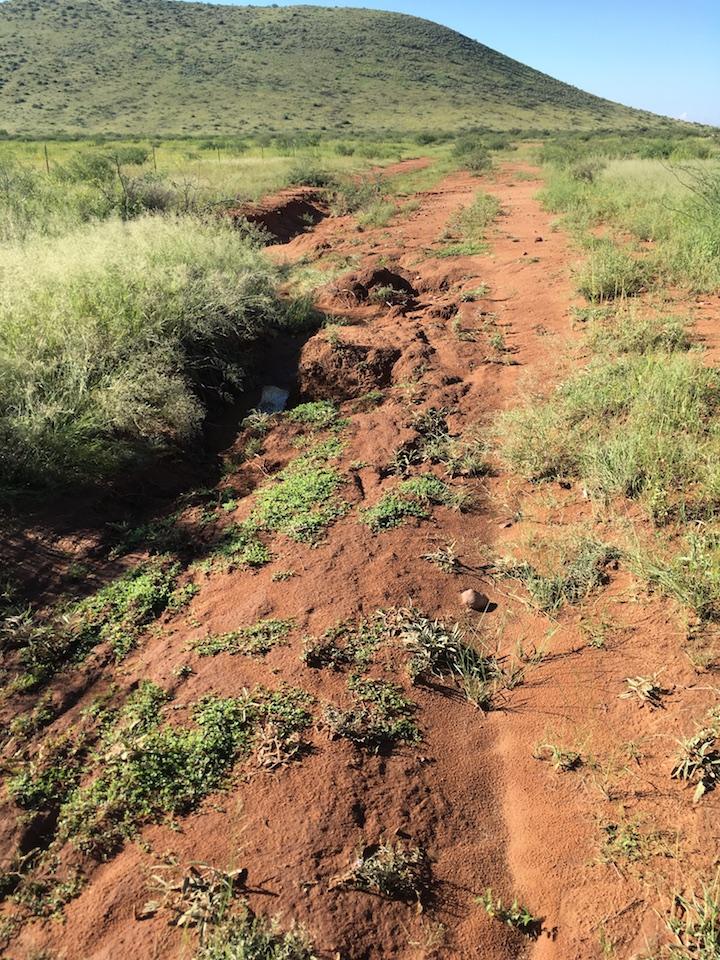
How can you differentiate an earth fissure from damage due to being in a flood zone?
AZGS Answer
Hi Kaitline,
Good question. Earth fissures tend to be curvilinear and frequently cut across drainages and erosional features. Also, a gully floor typically is graded downslope; fissures frequently are not so well graded and include local depressions where water pools. Have a look at some of our fissure pictures at our AZGS photo gallery (http://azgs.arizona.edu/azgs-photo-tags/earth-fissure)
I can't tell from your image, but it does look like a local erosional feature, which tend to follow local drainages. Let me know if I can help further.
All mapped earth fissures in Arizona are displayed at the Natural Hazards in Arizona Viewer. Check it out at: http://uagis.maps.arcgis.com/apps/webappviewer/index.html?id=98729f76e46...
Mike